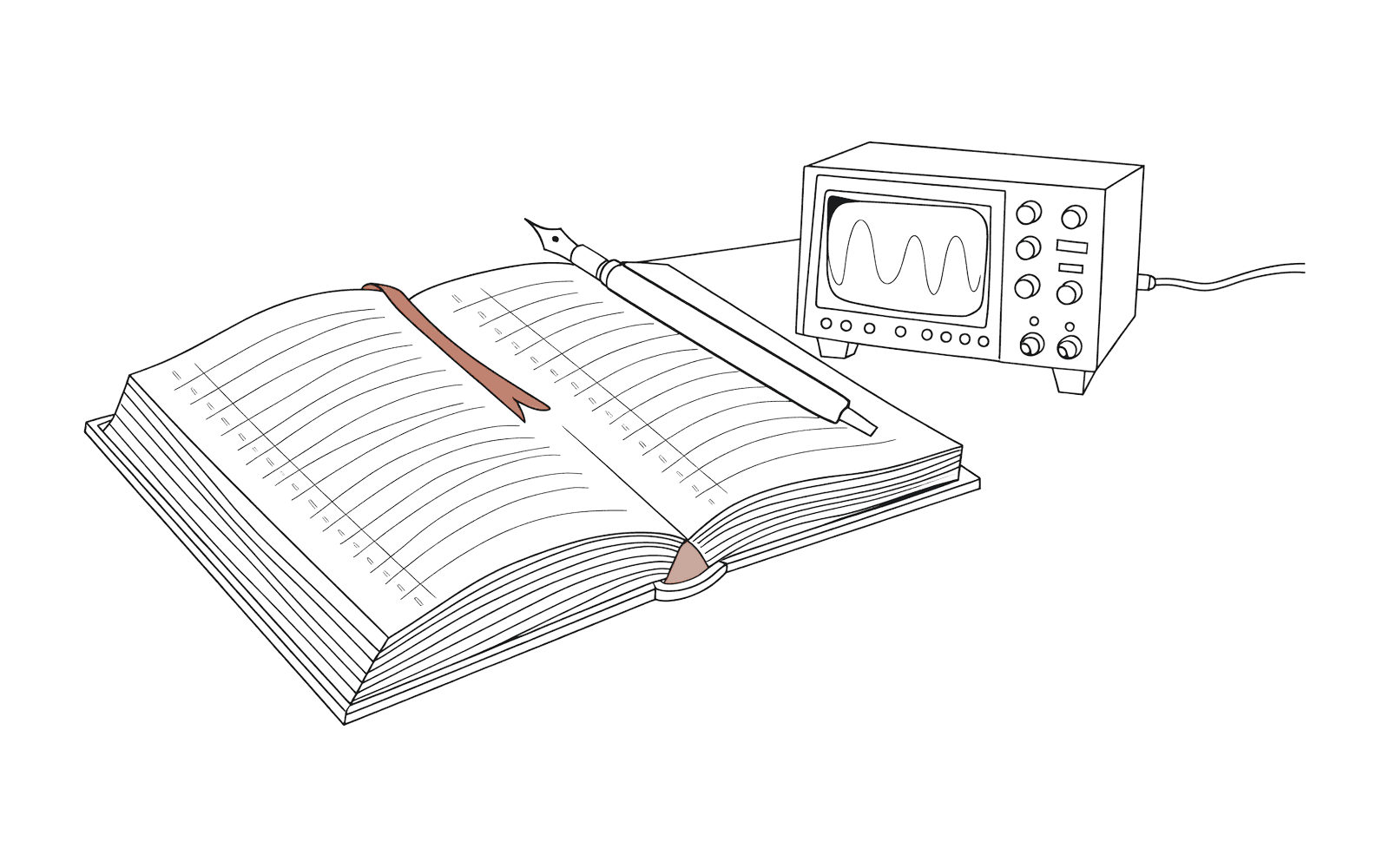
If you keep an engineering logbook, somebody told you the rules early. A bound book, not a ring binder. Numbered pages, none torn out. Ink, not pencil. Date every entry. Rule a line through the blank part of the page so nothing can be added later. And if the work matters, have someone else read it and sign across the bottom.
Those rules are not about tidiness. They exist because the logbook is a document that may one day have to prove when you knew something, and to whom. A bound sequence with witnessed pages is hard to alter after the fact, and that is its entire value in a dispute over who got there first.
Which puts you in an awkward position, because as a daily working tool the paper logbook has an obvious hole in it, and every obvious fix damages the thing that makes it worth keeping.
The hole
Almost nothing you need to refer back to is text you wrote.
It is the scope trace from the bench that afternoon. The photograph of the rig with the connector seated wrongly. The supplier's datasheet, the revision that was current in March and has since been replaced. The forty-second voice memo where the technician explained the failure while you both stood over it. The thermal image. The CSV.
None of that goes in a bound book. So the book records that you saw it, and the thing itself lives on a phone, in a shared drive, in an email thread, in a folder named after a project that has since been renamed. Six months later the entry reads: "scope shows ringing on rising edge, see capture". And the capture is gone, or it exists but you cannot say with confidence that the file you just found is the one that sentence refers to.
What people try
Tape the printout in. It works, and it is what the rules assume you will do. It also doubles the thickness of the book, the tape lets go in a year, and a printed screenshot of a waveform is a picture of data rather than the data. You cannot re-measure from it.
Photograph every page. Now you have a folder of images of pages. It is a backup, not a retrieval system. Finding the March entry means scrolling through photographs of pages that all look identical, which is the paper problem with an extra step.
Move to a tablet. This is the one that looks like the answer and is not. The moment the record is a file, the properties you were relying on are gone: the sequence can be reordered, a page can be replaced, timestamps are metadata and metadata is editable. There are systems built specifically to restore this — audit-trailed electronic notebooks with cryptographic signing — and they work, but they are procured, administered and paid for at the organisation level. They are not a thing you adopt on a Tuesday because your own book is annoying you.
Scan it into something searchable. Handwriting recognition on a real engineer's page — mixed print and cursive, subscripts, a circuit fragment, three abbreviations you invented — is not reliable enough to search against, and a scan is a copy. A copy proves nothing about when. The original book still has to exist, so you now maintain two records and trust neither completely.
What you actually need
Notice that none of the above is really about provenance. Provenance is fine: the book does that job, and it does it by sitting in a drawer being a book.
The problem is narrower. You need the page in front of you to be able to point at the file that belongs to it, in a way that still works in five years and does not require you to have named anything carefully at the time.
That is a much smaller problem than digitising a logbook, and it does not require touching the page in any way that matters.
The smallest version of a fix
No special notebook. No special pen. Nothing to print, cut to size or stay inside the border of. The two products usually named in this conversation — Rocketbook and Livescribe — each require one or the other, and in a bound logbook neither is available to you anyway: you cannot swap the book for a branded one without throwing away the sequence that makes it worth keeping.
Write four characters in the margin.
That is the whole mechanism. When you save the scope capture, the app hands you a short code — four characters, say QJFT. You write QJFT next to the entry, in ink, the way you would write any other note. Later you point your phone's camera at the page and the capture opens.
Nothing reads your handwriting. The only thing being recognised is four characters you chose and wrote deliberately, which is a far easier problem than reading a page of engineering shorthand, and it fails in an obvious way rather than a silent one.
For the logbook specifically, the properties that matter survive intact:
- The book is still bound, still sequential, still ink on numbered pages.
- The margin code is an entry like any other. It was written at the same time as the line beside it, in the same pen, and it is inside the witnessed page.
- Nothing is torn out, pasted in, or added to the page after signing.
- The book remains readable and meaningful without any device, which is the test that rules out most alternatives. Someone reading it in ten years sees a four-character note they cannot resolve — exactly as they would see a filename you had written by hand, except that this one still resolves for you.
It is worth being clear about what this does not do. It does not make the attachment itself tamper-evident, and it does not make your logbook admissible if your process was sloppy in other ways. If you are in a regulated environment with a validated electronic records requirement, you need the audit-trailed system and you know it already. This is for the very large number of engineers whose logbook discipline is professional habit rather than statutory obligation, and whose real daily loss is not a patent dispute but twenty minutes of hunting for a file they know exists.
Why this is the shape of the answer
The reason the tablet fails this audience is not that the hardware is bad. It is that the pitch is replace the paper, and the paper was never the problem. The paper is doing something well. The failure is that the page cannot reach anything outside itself.
So fix that, and only that. Leave the book alone.
Warq is not out yet — it is being built now, and the waiting list is open. If you keep a logbook, the four characters in the margin are the part worth arguing with: warq.app.