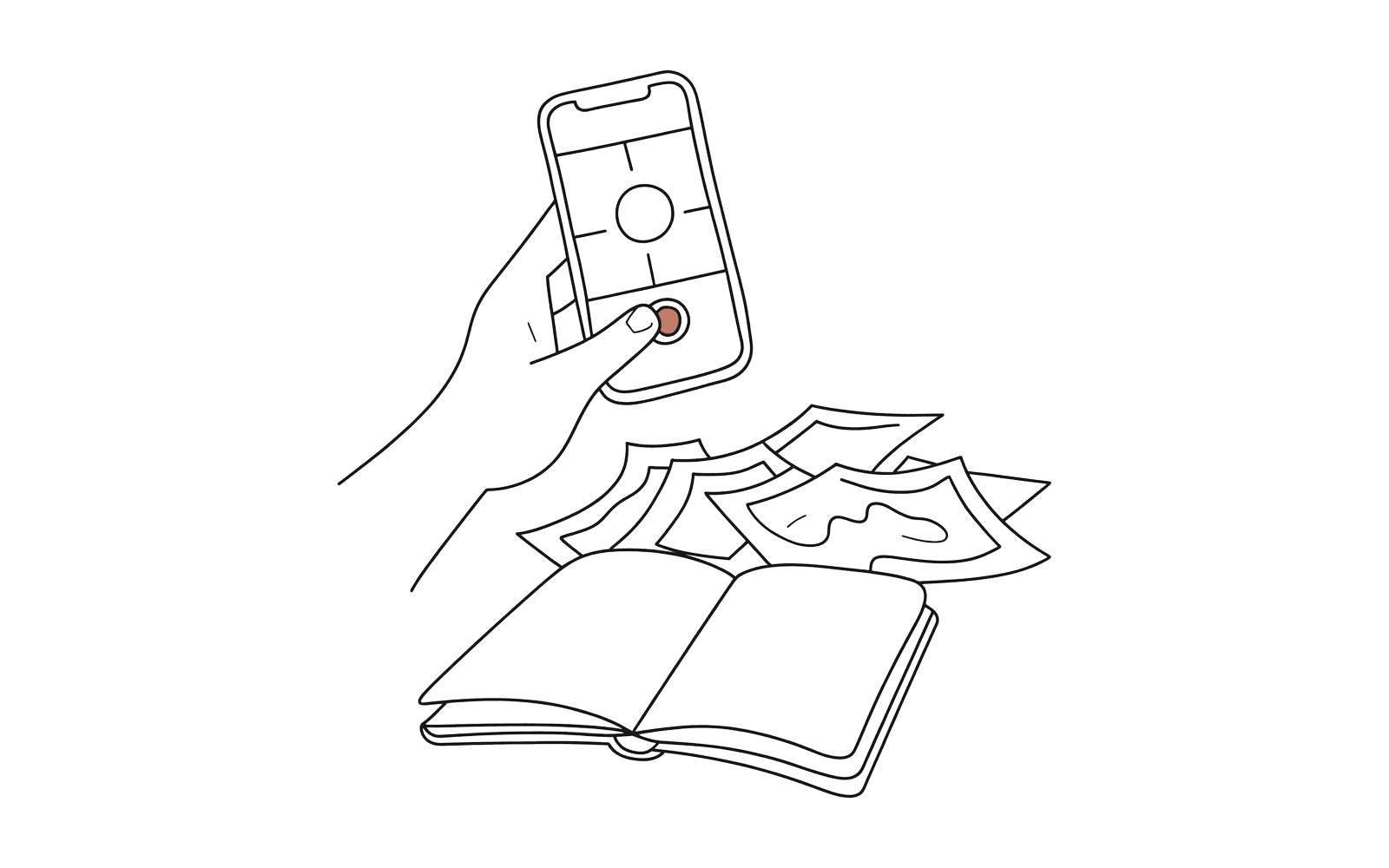
Somewhere in a thread about combining paper and digital notes, past all the people describing elaborate setups, someone describes what they actually do. They write on paper during the day. In the evening they spend five minutes photographing anything worth keeping and dropping it into a single folder. No tags. No folders within folders. No naming convention. They search later, if they ever need to.
And they finish with the line that makes every note-taking product uncomfortable: most of your notes you never look at again, so why bother with a system.
That is a better strategy than most of the things sold to replace it, and any honest argument has to start by saying so.
What it gets right
It has almost no ongoing cost. Five minutes, once, at a predictable time. No decision at the moment of writing, which is the moment you have the least attention to spare.
It never breaks. There is no subscription, no proprietary format, no company that can disappear. A folder of images opens in thirty years.
It is honest about the ratio. Most notes genuinely are written to think, not to keep. The act of writing did the work; the artefact is a by-product. A system that treats every page as precious is optimising for a case that mostly does not happen — and the effort it charges is paid on all of them, every day, forever.
Most note-taking products lose to this strategy and do not understand why. They ask for effort on every note in exchange for value on the rare one. The arithmetic does not work, and users feel it long before they can articulate it.
The one place it breaks
Notice what the strategy quietly assumes: that the 10% you need later can be found by searching the folder.
It cannot, and for a specific reason. The folder contains photographs of handwriting. Photographs of handwriting are not searchable in any way you can rely on. Phone libraries have become good at reading printed text in images — a receipt, a street sign, a slide — and remain unreliable on handwriting, especially handwriting written at speed, in a second language, or with a diagram in it. Someone in that same thread had tried exactly this and reported that it was badly insufficient in French, and worse with diagrams.
So "search later" tends to mean scroll later. Which, on a folder of eleven thousand photographs of similar-looking pages, is not searching.
There is a second problem, quieter and worse. The photograph is a picture of the page. The thing the page refers to is not in it. Your note says see whiteboard, and the whiteboard photo is in the same undifferentiated folder, two hundred images away, with nothing connecting them. Your note mentions the recording, the PDF, the datasheet — all of which exist, none of which the page can reach.
The shrug strategy captures the page and loses the page's relationships. And it is the relationships you are almost always trying to recover when you finally go looking.
So what would be worth the effort?
Only something whose cost is near zero at the moment of writing. That is the real test. Anything that asks you to stop, tag, name, file or transcribe has already lost to the folder, because the folder asks for none of that.
Here is the version we think passes.
When you save a file — the photograph of the whiteboard, the voice memo, the PDF someone handed you — you get back four characters. You write those four characters in the margin. CBDX. That is the entire cost, and it is paid once, on the small number of notes that actually point at something.
Later, you point your phone's camera at the page and the file opens.
Compare the two honestly:
| Photograph everything | Four characters in the margin | |
|---|---|---|
| Effort per note | none | none, on the 90% |
| Effort when a note refers to something | none | about two seconds |
| Evening batch | five minutes, daily | none |
| Finding a page later | scroll | you still have the paper notebook, as before |
| Finding what a page refers to | scroll, hope | point the camera |
| If the company disappears | folder still opens | notebook still reads; you are left with some four-letter groups |
The row that matters is the second-from-last. Everything else is roughly a draw, and a draw against a strategy with zero cost is a good result.
What this is not
It is not full-text search of your handwriting. Nothing here reads your notes — the only thing recognised is four characters you chose and wrote on purpose, which is why it works on bad handwriting, on any language, and on pages that are mostly diagram. If what you want is to type a word and find every page containing it, this is not that, and the products that promise it will disappoint you for the reasons above.
And it needs no special pen and no special paper. That objection arrives fully formed, because the two products people usually name in these conversations — Rocketbook and Livescribe — both require one or the other, and the ceremony around them is exactly the kind of cost that loses to a folder. Any notebook. Any pen. The page stays a page.
If you genuinely never need the 10%, do nothing. The folder is fine, and so is the shrug. This is written for the version of you that went looking, found the page, and discovered the thing it pointed at was gone.
Warq is being built now. The waiting list is open at warq.app.